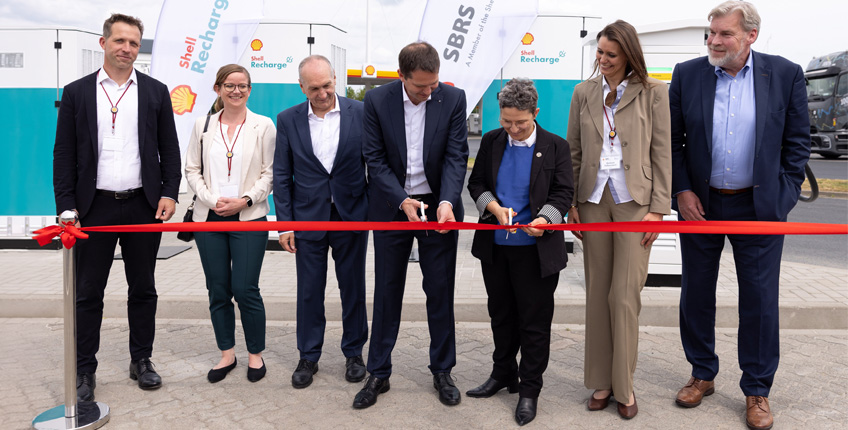
The “HoLa – High-Power Charging for Long-Haul Truck Transport” project demonstrates that electric trucks can also be used reliably over long distances. The new facility in Lehre serves as a key hub along this corridor. Representatives from politics, industry and logistics gathered for the official opening ceremony, including State Secretary Dr. Claudia Elif Stutz from the Federal Ministry of Transport as well as leading manufacturers of commercial vehicles and companies from the transport sector.
State Secretary Dr Claudia Elif Stutz, Federal Ministry of Transport: “For the market adoption of electric trucks in freight transport, it is crucial that they can be charged reliably and quickly. With this BMV-funded project, politics, research and industry are jointly accelerating the decarbonisation of road freight transport. The consortium is demonstrating how the particularly fast megawatt charging system (MCS) can be used in long-haul transport. The completed MCS corridor between the Ruhr region and Berlin now demonstrates that freight forwarders can operate even more economically and flexibly by using electric trucks.”
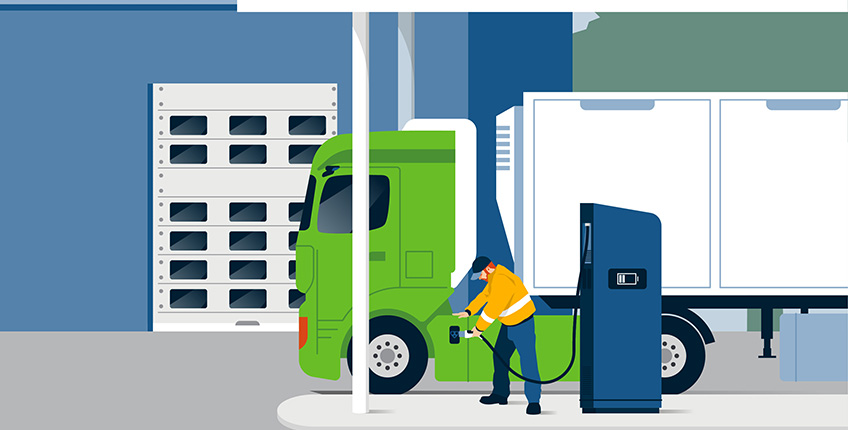
A megawatt charging process was demonstrated live during the event. The technology deployed by project partner Shell Business Recharge Solutions (SBRS) enables large electric trucks to be quickly recharged during statutory driving breaks and to continue their journey. The HoLa project thereby demonstrates what is possible when politics, industry, research and science, as well as the energy and logistics sectors, work together: a functioning system for electric long-haul transport – and a decisive step from pilot project to widespread application.
HoLa sets new standards for megawatt charging in long-haul transport
The HoLa project aims to demonstrate the technical and economic viability of battery-electric trucks in long-haul transport under real-world conditions and to pave the way for the nationwide expansion of the charging infrastructure.
Corridor and infrastructure
- Establishment of the first continuous high-power charging corridor along the Ruhr–Berlin motorway axis
- A total of five locations, strategically positioned along key logistics routes:
- Lehre near Helmstedt/Lower Saxony
- Lipperland Süd near Bielefeld/North Rhine-Westphalia
- Hamm-Rhynern/North Rhine-Westphalia
- Dortmund/North Rhine-Westphalia
- Wustermark/Brandenburg (to be operational in the coming weeks)
Megawatt Charging System (MCS)
- Use of state-of-the-art charging infrastructure for heavy commercial vehicles
- Charging power of up to 1.2 megawatts
- Objective:
- Recharging designed to coincide with a 45-minute driver break
- Range extension of several hundred kilometres
Practice-oriented operation
- Testing under real-world conditions along a key logistics corridor
- Involving:
- Leading truck manufacturers (OEMs)
- Logistics companies and fleet operators
- Investigation of:
- Grid connection and energy requirements
- Charging behaviour and user requirements
- Integration into existing transport processes
Project structure and funding
- Funded by the Federal Ministry of Transport with approximately 10 million euros
- Supplementary funding via European programmes (NextGenerationEU / Recovery and Resilience Facility)
- Implementation as part of the overarching ‘Climate-friendly Commercial Vehicles’ concept
- Coordination by Fraunhofer ISI and P3 Group
- Consortium comprising 13 partners and 12 associated partners from industry, energy, infrastructure and research
Significance for market ramp-up
HoLa provides key insights for:
- The nationwide expansion of charging infrastructure for heavy commercial vehicles
- The scaling of megawatt charging
- The further development of regulatory frameworks and business models
The project therefore marks the transition from the pilot phase to the widespread industrial application and scaling of zero-emission technologies in road freight transport.
About the HoLa projekt
HoLa (“High-Power Charging in Long-Haul Truck Transport” – in German: “Hochleistungsladen im Lkw-Fernverkehr”) is a flagship project for the electrification of road freight transport. The aim is to test high-power charging infrastructure under real-world conditions and to lay the foundations for a rapid uptake of zero-emission logistics in Germany and Europe. HoLa is funded by the Federal Ministry of Transport with a total of 10 million euros under the Electric Mobility Funding Guidelines and is being conducted as a technology and testing project as part of the implementation of the overarching “Climate-Friendly Commercial Vehicles” concept. Funding for this measure is also being provided under the German Recovery and Resilience Plan (DARP) via the European Recovery and Resilience Facility (ARF) within the NextGenerationEU programme. The funding guideline is coordinated by NOW GmbH and implemented by Project Management Jülich (PtJ). The National Centre for Charging Infrastructure, operating under the umbrella of NOW GmbH, is also closely involved in the HoLa project. The project consortium comprises a total of 13 partners from the fields of vehicle manufacturing, energy supply, grid operation, motorway management and research. Overall management and scientific coordination are the responsibility of Fraunhofer ISI.
Johannes Pallasch, Head and Spokesperson for the National Centre for Charging Infrastructure, under the umbrella of NOW GmbH: “HoLa impressively demonstrates the pivotal role that megawatt charging plays in the electrification of heavy goods transport. The findings from the project have been incorporated into the tender for truck charging infrastructure on motorways, thereby making an important contribution to the accelerated roll-out of an efficient charging network for heavy commercial vehicles in Germany. The National Centre for Charging Infrastructure will continue to support and drive this expansion with its expertise.”
Dr Götz von Esebeck, Head of Technology Strategy & Innovation at Traton SE: “Vehicles are available and the portfolio is constantly expanding. The key factor now is the rapid expansion of a high-performance charging infrastructure. HoLa demonstrates how this synergy enables the adoption of electric mobility in heavy long-haul transport.”
Sascha Hähnke, Managing Director of Remondis Sustainable Services GmbH: “The HoLa station in Lehre represents the technological bridge between the demand for sustainable logistics and the real-world operation of electric long-haul trucks. This makes the new HoLa charging station a key building block on the path to CO2-neutral heavy goods transport in Germany and Europe.”
Melanie Falkenstern, Head of Shell Fleet Solutions DACH: “With the start of operations in Lehre, we are bringing high-power megawatt charging into real-world customer use. For our fleet customers, this is a decisive step towards making electric mobility economically viable in long-haul transport.”
Conrad Mummert, Head of SBRS (Shell Business Recharge Solutions): “HoLa demonstrates that megawatt charging works reliably from a technical perspective and can be integrated into existing operational processes. The experience gained from the project provides an important foundation for the large-scale roll-out of this technology.”
Image: Shell Deutschland GmbH