Federal Transport Minister Patrick Schnieder: “We have already invested around 1.5 billion euros in more than 5,300 climate-friendly buses. We are deliberately continuing down this successful path: With the available budget for 2026 alone, we intend to put an additional 1,500 e-buses into operation nationwide. This strengthens local public transport, the market ramp-up of innovative drive technologies and smooths the path towards climate-friendly mobility.”
With the new funding guidelines, the BMV is also continuing to support transport companies and operators in the bus industry in converting their fleets to emission-free buses with battery or fuel cell drives. The goal is to accelerate the rollout of climate-friendly buses, increase market penetration and also create market incentives in the intercity, long-distance and tour bus segments. This funding therefore contributes significantly to reducing greenhouse gas emissions in local transport and supports national climate protection goals.
The new funding call is based on the 2026 federal budget, which once again allocates funds for alternative drive systems in local transport. Federal Minister Patrick Schneider had already announced the relaunch of the funding programme at the BMV’s Climate-Friendly Buses conference in February 2026.
Project proposals can be submitted from 26 May, 2026
Project proposals can be submitted from 26 May 2026 via the easy‑Online funding portal. The proposal phase is eight weeks long; The project deadline is 21 July 2026.
What can be funded?
Funding is available for the purchase or retrofitting of buses with alternative drives in passenger transport as well as the required charging and refuelling infrastructure:
- Battery buses (including battery trolley buses)
- Fuel cell buses (including battery buses with fuel cells as range extenders)
- Retrofitting of conventional buses to battery or fuel cell drives
To ensure efficient and effective use of the funding, it will be distributed across various technology funding areas, taking into account the level of electrification and application context. In addition to an ‘activation programme’ that follows on from the existing funding procedure, a ‘scaling programme’ will be introduced for the first time. This will be geared towards companies that have already electrified a significant portion of their bus fleets and plan further vehicle expansions. Within the funding pillars, projects will be selected in a competitive procedure, taking into consideration their climate contribution and the efficiency of funding use. Additionally, the implementation potential and operational and energy concepts will be evaluated.
Results of the existing funding
Since the introduction of the first guideline in 2021, the procurement of more than 5,300 buses at around 330 transport companies have been approved, of which more than 2,300 vehicles are already in operation. Over their service life, these buses will potentially save over four million tonnes of CO₂. You can see an overview of grant recipients here.
The funding is being implemented through NOW GmbH and Project Management Jülich (PtJ). Some of the funding so far has been cofinanced under the German Recovery and Resilience Plan (DARP) through the European Recovery and Resilience Facility (ARF).
Information event and further information
In addition to the funding call, an online information event will take place on 28 May 2026 at 1pm. Please register here.
Further information:
- Link to the funding guideline
- Documents on the funding call from the project management agency
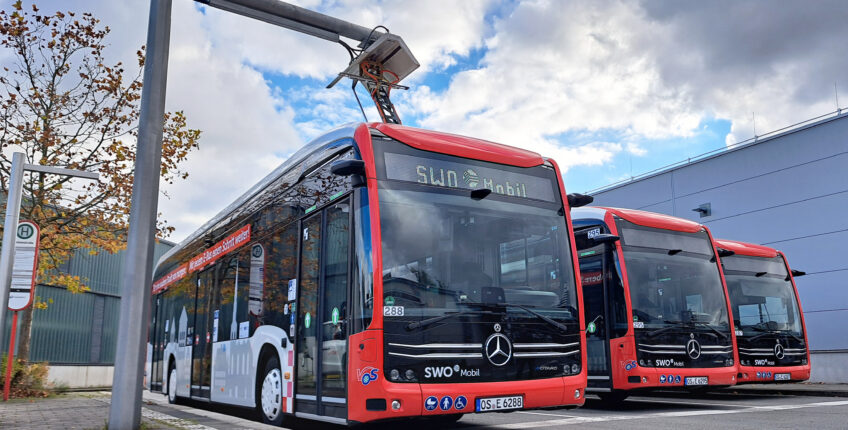
Caption: Three of the 19 eCitaro solo buses funded by SWO Mobil.
© Stadtwerke Osnabrück / Marco Hörmeyer