Patrick Schnieder, Federal Minister of Transport: “By supporting climate-friendly drives in local public transport, we are providing targeted impetus for sustainable and future-proof mobility. REVG is leading the way here. We are backing the switch to zero-emission buses with 7.48 million euros of funding support.”
Every day, REVG takes passengers to school, work, the doctor or their leisure activities. This is achieved by more than 270 buses operated by REVG and contractors in the Rhein-Erft district, which cover 9.2 million kilometres per year. The deployment of 26 completely emission-free hydrogen buses, which are replacing the previous diesel buses in the REVG fleet, will reduce climate-damaging greenhouse gas emissions. Compared to conventional diesel buses, this amounts to around 1,500 tonnes of CO2 per year.
Hydrogen filling station at the depot
“Refuelling takes place at the REVG depot at the hydrogen filling station, which was built in October 2024. It is supplied exclusively with green hydrogen. ‘With green hydrogen, we meet the requirements for funding support of the Federal Ministry, for the procurement of vehicles. The refuelling station infrastructure ensures that our vehicles are operational 24 hours a day, seven days a week. The hydrogen filling station and supply are provided by the Messer Group, the specialist for industrial, medical and special gases,” explains REVG Managing Director Walter Reinarz.
Gregor Golland, Chairman of the Supervisory Board of REVG, emphasises: “The decision in favour of hydrogen technology is based on a feasibility study and a forward-looking strategic approach. As the Supervisory Board, we stand behind this technological innovation and welcome the sustainable development of our transport company.”
REVG remains open to new technologies
REVG’s procurement strategy involves carefully weighing up technological feasibility, economic efficiency and environmental impact. Looking to the future, REVG Managing Director Martin Gawrisch explains: “Whether hydrogen will be the central energy source in the long term remains to be seen – but we will continue to strive to use vehicles with alternative fuels.”
The conversion of part of the bus fleet to hydrogen is being funded by the Federal Ministry of Transport (BMV – Bundesministerium für Verkehr) with a total of €7.488 million as part of the directive on the promotion of alternative drive systems for buses in passenger transport. Funding for this measure is also being provided as part of the German Recovery and Resilience Plan (DARP – Deutscher Aufbau- und Resilienzplan) via the European Recovery and Resilience Facility (RRF) in the NextGenerationEU programme. The funding guideline is coordinated by NOW GmbH and implemented by the project management agency Jülich (PtJ).
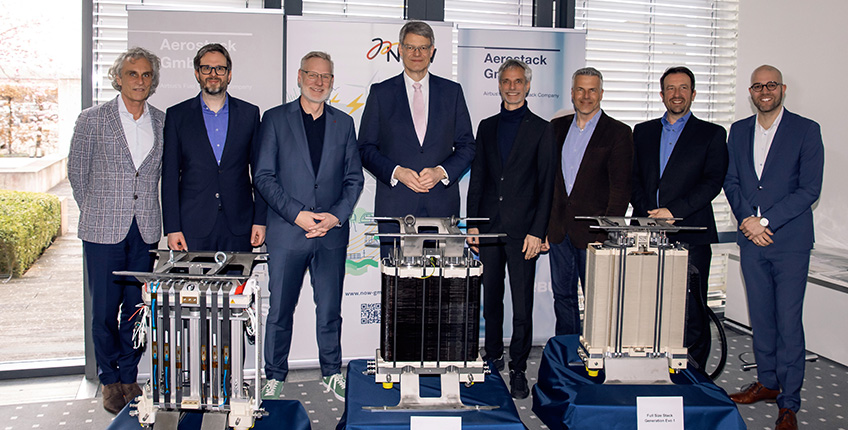
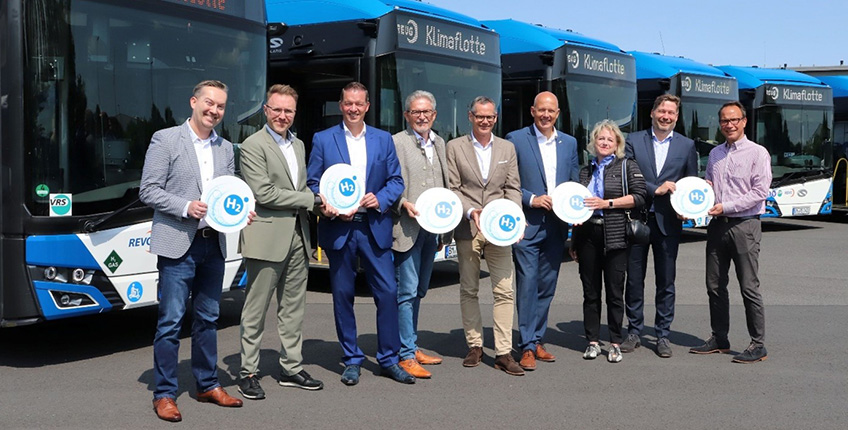
Photo (from left to right):
Benedikt Glorius, Spedition Rheinland Hilde Freund GmbH & Co. KG, Andreas Noky, Messer SE & Co. KGaA, Gregor Golland MdL (Chair of the Supervisory Board of REVG), REVG Managing Director Walter Reinarz, Christian Goll, Managing Director of Solaris Bus Deutschland GmbH, Frank Rock, District Administrator of the Rhein-Erft district, Regina Böhmer (Chair of the REVG Shareholders’ Meeting), REVG Managing Director Martin Gawrisch, Alexander Döres, Spedition Rheinland Hilde Freund GmbH & Co. KG.
Source: REVG