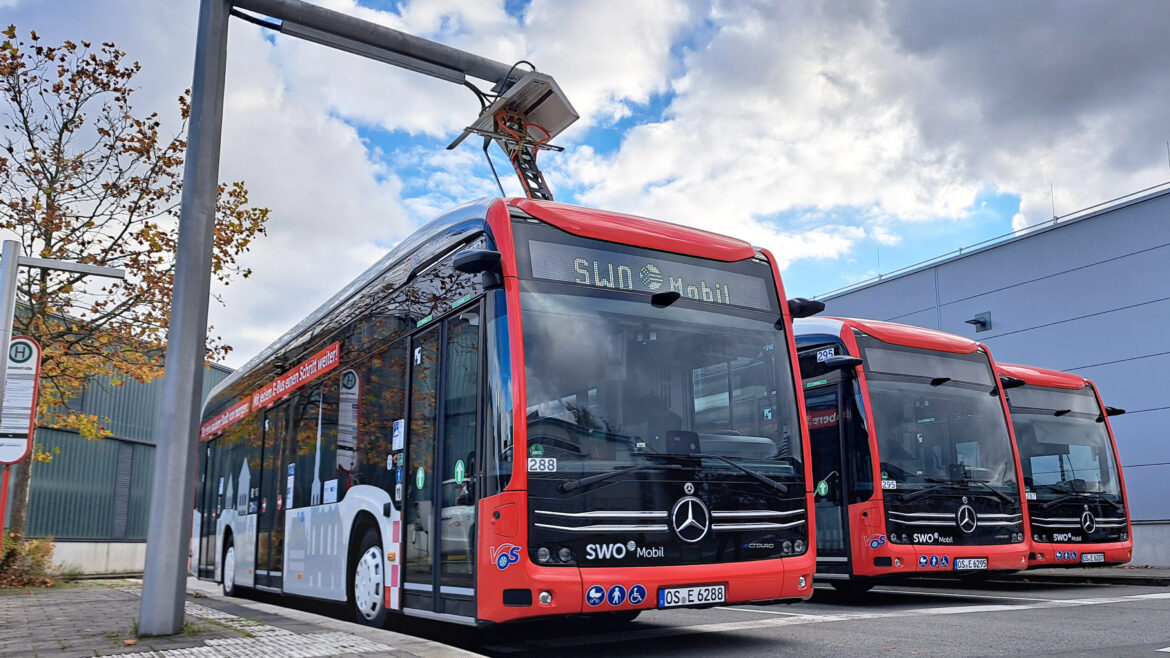

The expansion of the eco-friendly bus fleet was supported by two funding packages from the Federal Ministry of Transport (BMV) totalling around 16 million euros. Thanks to this BMV funding, Autokraft was not only able to purchase a total of 40 electric buses and two fuel cell buses, but also expand its charging infrastructure and maintenance facilities. All electric bus projects have been implemented in close coordination with the local public transport authorities in the districts and municipalities.
Johannes Wieczorek, Division Head at the BMV: “With our funding, we are ensuring more climate-friendly buses in local public transport and thus better air quality and lower CO2 emissions locally. Autokraft GmbH is representative of the Deutsche Bahn companies that are committed to electrifying bus operations and thereby setting an example. I am delighted that we have been able to support the procurement of almost 200 buses with €59 million under the funding guideline.”
Daniel Marx, Chairman of the Regional Management of DB Regio Bus Nord and Managing Director of Autokraft GmbH: “Around ten percent of the DB Regio Bus Nord fleet is now emission-free. We are actively shaping the future of mobility and take our responsibility for climate protection seriously. With the help of the BMV funding and in cooperation with the districts in Schleswig-Holstein, we have taken a big step towards climate-neutral public transport.”
Kai Schlimbach, Head of Regional Development, Construction and Environment in the Rendsburg-Eckernförde district: “The switch to climate-neutral drives has a direct impact on the quality of life of local people: We are improving air quality and reducing noise pollution. Saving diesel conserves resources and will reduce costs in the long term, which in turn can be invested in the quality of public transport. The district of Rendsburg-Eckernförde is strongly committed to modern, climate-friendly public transport that is tailored to people’s needs. We can be proud of that!”
The 40 electric buses and two fuel cell buses were purchased with funding from the BMV under the ’Guideline for the Promotion of Alternative Drives for Buses in Passenger Transport‘ (’Richtlinie zur Förderung alternativer Antriebe von Bussen im Personenverkehr”) since 2022. Funding for this measure is also being provided under the German Recovery and Resilience Plan (DARP – Deutscher Aufbau- und Resilienzplan) through the European Recovery and Resilience Facility (RRF) as part of the NextGenerationEU programme. The funding guidelines are coordinated by NOW GmbH and implemented by Project Management Jülich (PtJ).
Detailed information on climate-neutral public transport in northern Germany is available (in German) at: www.dbregiobus-nord.de/aktuell/mobilitaetswende
Source/Image: DB AG