Potential partners have already been identified during the project – the first charging cooperation between Berliner Wasserbetriebe and energy provider Vattenfall, on a parking lot owned by the retail company Netto, is in preparation.
The Retail4Multi-Use project is funded by the Federal Ministry of Transport with a total of €1,657,555.52 under the electric mobility funding guideline. Funding for this measure is also provided under the German Recovery and Resilience Plan (DARP – Deutcher Aufbau- und Resilienzplan) via the European Recovery and Resilience Facility in the NextGenerationEU programme. The funding guideline is coordinated by NOW GmbH and implemented by Project Management Jülich (PtJ).
Christian Hirte, Parliamentary State Secretary at the German Federal Ministry of Transport: “With the Retail4Multi-Use project, we are showing how charging infrastructure can be used efficiently by supermarket customers and fleet operators. This multiple use has great potential: customers charge while shopping, and the charging infrastructure is available to commercial users outside opening hours. The mediation platform developed for this purpose is an innovative approach that will be pursued in the future.”
Friederike Reisch, Head of the Mobility with Renewable Energies research department at RLI: “We have determined which concepts can help to use charging infrastructure in supermarket parking lots more efficiently. Our results are particularly useful for commercial players with vehicle fleets, but without sufficient in-house charging infrastructure. They facilitate the electrification of the vehicle fleet through better access to charging infrastructure and support operational processes.”
Nils Brätsch, Technical Service / Fleet Management at the Berliner Wasserbetriebe: “Some colleagues such as those from the laboratory or metering, often have long tours throughout the city. The multi-use concept enables us to quickly charge close to places of use and can therefore help to save travel time to depot charging at the local depot. That is something that can also be transferred to other companies.”
Annemarie de Jong, Director Sales & Operations Vattenfall E-Mobility Deutschland: “Supermarket parking spaces are a decisive lever for bringing electromobility into everyday life. Together with partners such as Netto, we are showing here how high-performance fast charging can work in urban areas – close to everyday life, grid-friendly and with 100 percent green electricity. For us at Vattenfall, one thing is clear: people want to charge where they are anyway – when shopping. That’s why we are making targeted investments in high-quality retail locations and linking them to smart charging to relieve grids and reduce costs. Today’s example shows how research and practice can work together to advance the energy transition.”
Michael Linander, CEO Netto Deutschland: “As part of our corporate strategy at Netto, we prioritize climate awareness and sustainable solutions. By expanding the charging infrastructure in our car parks, we are creating real added value for our customers and our colleagues as well as for our common home.”
Dr. Jan Grippenkoven, Head of the Transport Department at the DLR Institute of Transport Research: “With our analyses and predictions of the requirements and needs of the stakeholders involved, we were able to contribute the necessary basis for identifying efficiencies in Berlin’s important charging infrastructure development.”
Berlin will need around 330,000 charging points by 20245
The project’s calculations show that Berlin will likely need around 330,000 charging points by 2045 to supply around 1.4 million electric cars and light commercial vehicles in the city. That is ten times the current number of charging points. Demand in non-public areas, such as private car parks, will be around four times higher than in public areas. Better use of existing charging infrastructure can therefore ease the burden of expansion and ensure a better supply of electricity for e-vehicle users. The potential for charging sessions that can be shifted to charging infrastructure at retail locations in Berlin amounts to up to 3,500 MWh per week for the year 2035. This corresponds to the energy requirements of almost 45,000 households in the same period. For the charging demand analysis, the project team used modelled driving profiles from real mobility data and simulated the results with the open-source tool SimBEV developed by RLI and the DLR tool CHARGIN.
The project shows how existing space in neighbourhoods can be used as efficiently and collaboratively as possible. If parking spaces and charging points are open to different user groups, the need for new charging facilities in public spaces can be reduced. This reduces land use, facilitates the integration of charging infrastructure into existing structures and strengthens local acceptance. Such shared use supports sustainable, socially balanced and future-oriented urban development. The research project therefore contributes to Measure 52 of the Federal Ministry of Transport’s Charging Infrastructure Master Plan II, which provides for the testing and implementation of multi-use concepts for charging infrastructure. The National Centre for Charging Infrastructure, under the umbrella of NOW GmbH, supported the project with its expertise in stakeholder workshops.
Online platform facilitates charging partnerships
As a further result, the project team has developed a matching platform in collaboration with project partner Localiser RLI. This digital application helps to facilitate partnerships between fleet operators and charging infrastructure operators. It is scheduled for release in the fourth quarter of 2025. In addition to providing benefits for Berlin, the results of the project can also be utilised by other urban centres.
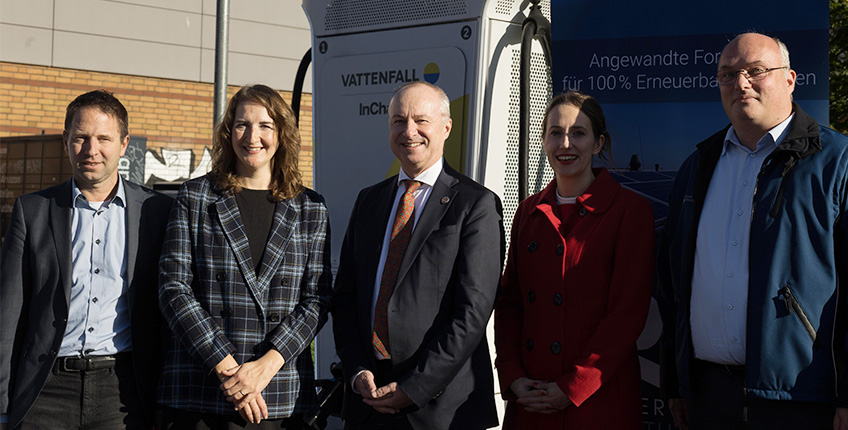
Image caption: from left to right: Prof. Dr. Gernot Liedtke, Director of the DLR Institute of Transport Research; Prof. Dr. Kathrin Goldammer, Managing Director of the Reiner Lemoine Institute; Johannes Wieczorek, Head of the Department for Policy Issues at the Federal Ministry of Transport; Annemarie de Jong, Director of Sales & Operations at Vattenfall E-Mobility Germany; and Volker Lengnick, Team Leader of Vehicle Services at Berliner Wasserbetriebe, at the presentation of the project results on 13 October 2025 in Berlin. | Image credit: RLI/Pinja Saarela
Source: www.reiner-lemoine-institut.de