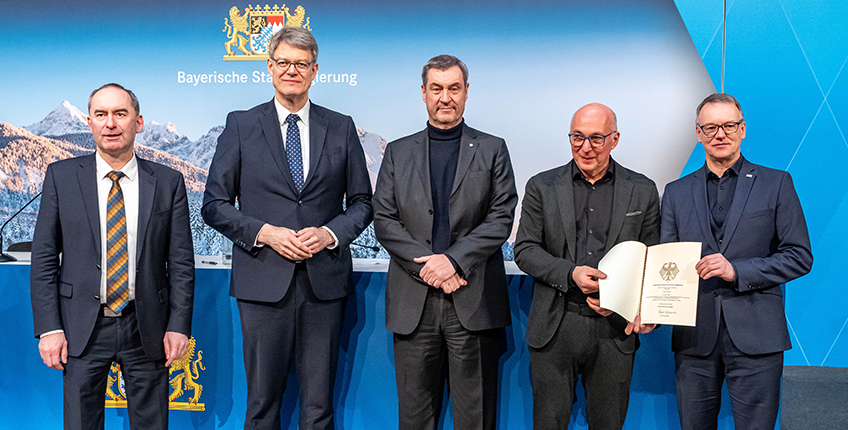
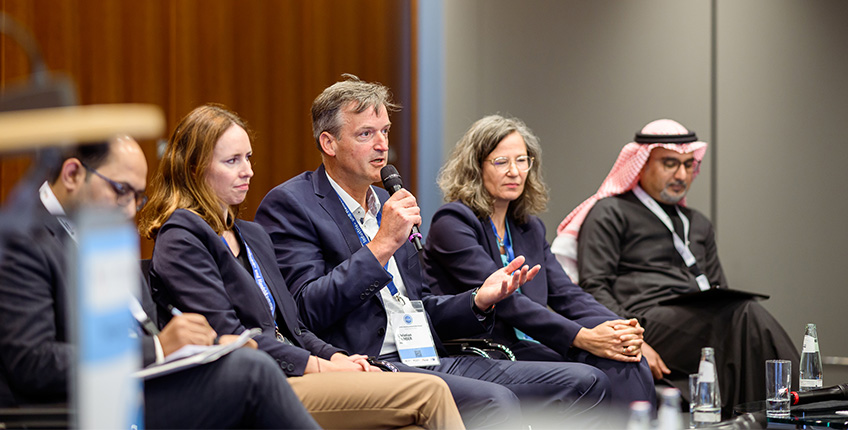
This week, Berlin is the meeting point for high-level representatives from politics, government and international professional organisations. At the 45th Steering Committee Meeting of the International Partnership for Hydrogen and Fuel Cells in the Economy (IPHE), delegates from a total of 27 IPHE member states discussed current developments, priorities and next steps in building a global hydrogen economy, among other topics.
The focus is on key issues of international cooperation: How can hydrogen markets be further developed beyond borders? What infrastructure is needed, and how can regulatory frameworks be better coordinated? For the first time, a delegation from Kenya is taking part in the Steering Committee of the IPHE, thereby expanding the group of a total of 28 participants, including the European Commission.
Dagmar Fehler, Spokesperson and CEO of NOW GmbH: “The IPHE shows how international cooperation can work in practice: Governments don’t have abstract discussions, but instead work together on issues relating to markets, infrastructure and standards. It is precisely this structured dialogue that is decisive in shaping the ramp-up of the hydrogen economy in a reliable and internationally compatible way.”
The Steering Committee is accompanied by a diverse programme that combines both policy as well as technical discussions with industry dialogues and practical insights into the hydrogen value chain. At the IPHE Industry and Outreach Day, delegates come together with representatives from business and industry in order to discuss central challenges of the market ramp-up – from supply and demand to the role of strong infrastructure as the backbone of functioning hydrogen markets.
The exchange is accompanied by so-called site visits, where specific hydrogen projects in Germany are toured. At Siemens Energy, delegates gain insights into the industrial manufacture of electrolysers – a key technology for generating ‘green’ hydrogen. Another technical visit highlights specific applications in the transport sector: At the Heidekrautbahn, the focus is on a hydrogen train from Niederbarnimer Eisenbahn, along with visits to hydrogen refuelling stations for rail, bus and truck transport. These visits clearly demonstrate how hydrogen technologies are already being used in mobility today.
Hydrogen as a building block for transformation
Germany has set itself ambitious climate goals and is aiming for climate neutrality by 2045. The transformation of energy, industrial and transport systems required for this needs technological innovations that combine both climate protection and economic competitiveness. Low-emission hydrogen is a major element. In the transport sector in particular, hydrogen supplements battery-electric mobility where direct electrification is somewhat limited – for example in heavy-duty transport, aviation or maritime shipping. At the same time, using hydrogen in transport contributes to creating reliable demand, building infrastructure and establishing the basis for functioning hydrogen markets.
International cooperation as a prerequisite
The development of a hydrogen economy is unthinkable without international cooperation. Hydrogen markets, infrastructure and standards cannot be developed in isolation on a national level. The IPHE provides a platform for political exchange, coordination and knowledge transfer. A current example is the IPHE report comparing hydrogen certification systems, the second edition of which will be presented in the coming week at the World Hydrogen Summit in Rotterdam and in which Germany played a leading role.
Funding, infrastructure and practical applications
The Federal Ministry of Transport has been providing targeted support for the ramp-up of hydrogen technologies for many years. Through the National Innovation Programme for Hydrogen and Fuel Cell Technology, more than one billion euros has been invested in research, development and market launch.
At the same time, one of Europe’s most advanced networks of publicly accessible hydrogen refuelling stations has been established. The current priority is expanding refuelling infrastructure for heavy-duty transport, with the goal of building more than 100 locations by 2030. In order to overcome the chicken and the egg problem, the BMV is funding both infrastructure as well as vehicles. Hydrogen buses and their respective infrastructure will continue to be financially supported.
About NOW GmbH
Since 2008, federally-owned NOW GmbH has been supporting the German government in implementing climate and industrial policy goals. It coordinates strategic projects on climate-friendly mobility and sustainable energy supply and promotes innovative technologies such as electric mobility and charging infrastructure, hydrogen and fuel cells, and alternative fuels. Its core mission is the efficient implementation of federal funding programs in these areas. In addition, NOW GmbH advises policymakers and promotes knowledge exchange through its networks in industry, municipal authorities, associations, and science. Through the National Centre for Charging Infrastructure, it manages the federal government’s activities to expand charging infrastructure in Germany. More information about NOW GmbH is available here.
Photo: Franz Josef, Berlin