Federal Transport Minister Patrick Schnieder: “Heavy-duty road freight transport is essential for Germany as an economic hub. At the same time however, this sector is tasked with becoming climate-friendly. With our one billion-euro funding programme, we are now creating the foundation for a speedy expansion of charging infrastructure and facilitating freight forwarders as well as logistics companies in switching to batter-electric commercial vehicles. We support companies that want to equip their depots with charging points as well as investors constructing publicly accessible charging infrastructure for heavy-duty commercial vehicles. One thing is clear: electric mobility in heavy-duty road freight transport can only be successful with a high-capacity infrastructure – and this is precisely the target of our funding.”
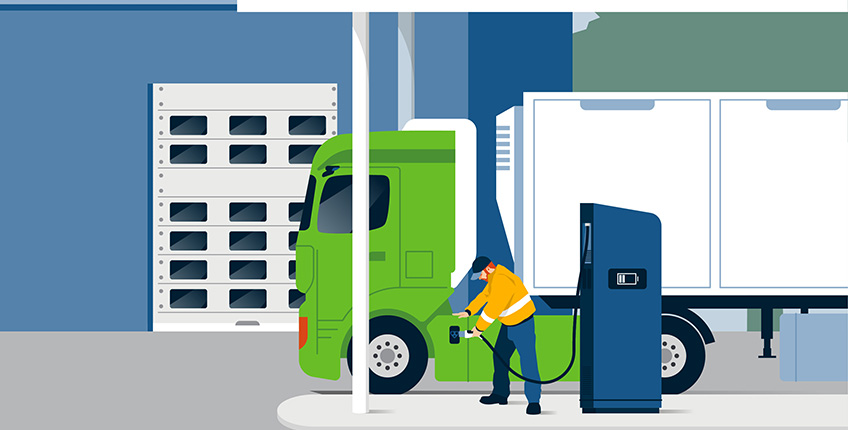
Battery-electric trucks have the potential to make the transport sector considerably more climate-friendly and also more robust in the context of fossil energy crises – provided that the necessary charging infrastructure is available. The BMV’s new funding guideline is part of the 2030 Charging Infrastructure Master Plan and tackles this exact issue. To best support the switch to battery-electric commercial vehicles, funding will be provided to not only charging infrastructure, but also the required grid connection, battery storage and charging and load management systems.
At the start of the funding programme, a funding volume of a total of 200 million euros for the following funding calls will be made available. Beyond 2026, further funding calls will be issued over the four-year period of the funding guideline, tailored to the respective market situation at hand.
- Funding call for non-publicly accessible charging infrastructure for small- and medium-sized enterprises: Applications can be made from 5 June 2026. The flat-rate funding will be provided on a first-come, first-serve basis.
- Funding call for non-publicly accessible charging infrastructure for all companies: Applications can be made from 26 May until 7 July 2026. Approval will be granted following completion of the competitive selection process.
- Funding call for publicly accessible charging infrastructure: Applications can be submitted from 26 May until 7 July 2026. Approval will be granted following completion of the competitive selection process.
In the competitive selection process, the main criterion for prioritisation will be the amount of funding per kilowatt of installed charging capacity.
Dagmar Fehler, CEO and spokesperson of NOW GmbH: “Small- and medium-sized companies as well as companies from the logistics sector in particular need practical solutions that can be simply implemented in everyday operations – and it is precisely here that the new BMV funding comes in. The National Centre for Charging Infrastructure provides comprehensive support to interested parties in preparing and implementing their projects. From initial planning to submitting the application, we stand as a supportive partner at the companies’ side, ensuring transparent information and reliable processes, as well as with information materials and tools accessible on our online platform.”
Online information event on 19/05/2026
Those interested in funding have the opportunity to inform themselves and pose questions at a free online event on Tuesday, 19/05/2026 at 9:30am. The online event is organised by the National Centre for Charging Infrastructure and implemented together with Project Management Jülich.
Registration is now open: Register here
Further information
More information on the funding guideline and the details of the three funding calls can be found here:
www.ptj.de/foerdermoeglichkeiten/lis-e-lkw
The three funding calls will also be presented in detail in the framework of specially tailored webinars in order to provide information on the specifics of each funding programme and clarify questions on the funding application. Further information can be found here:
- Online seminar on charging infrastructure for e-trucks – funding call: non-publicly accessible charging infrastructure for small- and medium-sized enterprises (2/6/2026)
- Online seminar on charging infrastructure for e-trucks – funding call: non-publicly accessible charging infrastructure for companies (2/6/2026)
- Online seminar on charging infrastructure for e-trucks – funding call: publicly accessible charging infrastructure (3/6/2026)
To support climate-friendly heavy-duty road freight transport, there is also an ongoing call to fund hydrogen refuelling stations for road transport in conjunction with commercial vehicles with hydrogen-based drives.
Useful resources on the topic of developing charging infrastructure for e-trucks
In addition to the funding guideline, the National Centre for Charging Infrastructure has today published a new short guide on installing charging infrastructure for battery-electric trucks at depots. It targets logistics and transport companies that want to electrify their fleets, providing clear and practical guidance – from needs assessment on paper to operating charging infrastructure in daily practice.
In addition, the National Centre for Charging Infrastructure is providing the following helpful resources on developing charging infrastructure for battery-electric trucks:
- Detailed guide: ‘Simple charging at depots’ (pdf)
The guide helps companies with truck fleets to begin the switch to electric mobility. Over three chapters, it outlines the main technical terms, uses examples to illustrate the process from planning to operating the charging infrastructure at the depot and takes a look at the economic aspects of the transition. The individual sections provide answers to the key issues and provide practical tips.
ㅤ - Interactive web version of the guide: ‘Simple charging at the depot’
ㅤ - Free e-learning course on the topic of ‘Truck charging infrastructure at the depot’
In three modules, the course provides a practical and compact outline of how to successfully install charging infrastructure for heavy-duty battery-electric commercial vehicles on private premises such as depots. The course is geared particularly towards logistics companies that are in the early phase of their fleet transition as well as operators of logistics hubs that wish to install charging infrastructure at their locations.