Dr. Hendrik Haßheider, Head of Department for climate-friendly commercial vehicles and infrastructure as well as Bremen’s Senator for Economic Affairs Kristina Vogt were there to gain an insight into the international logistics hub in Bremen. The focus was on a best practice example at Hellmann, which demonstrates the triad of self-generated solar energy, modern storage and charging infrastructure as well as electrically-powered trucks.
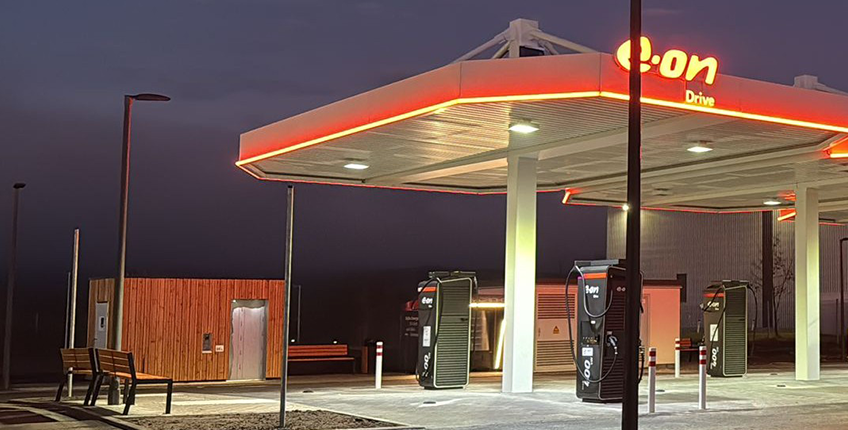
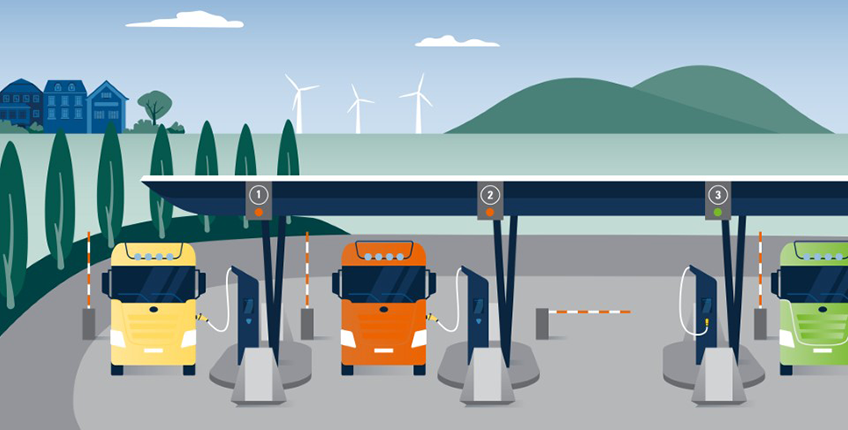
Since 2024, Hellmann has been operating its own e-trucks nationwide, funded by the federal government, and is already today demonstrating at the Bremen site how e-mobility can function in practice for future heavy goods transport. The decisive factor here is not only the question of range and infrastructure, but also future-minded site planning with a powerful photovoltaic system as well as storage and charging infrastructure suitable for trucks. For example, Hellmann has been successfully using two large, electrically-powered 40-tonne trucks in shuttle traffic to Osnabrück for the past year. On the basis of a differentiated charging concept, the trucks cover between 550 and 700 kilometres daily in two-shift operation. The middle mile between the two large Hellmann locations of Osnabrück and Bremen, which is considered to be difficult to decarbonise, is also covered in a CO2-neutral manner through the company’s own 300 kW charging infrastructure suitable for trucks, including buffer storage.
The development of the e-truck fleet and the charging infrastructure is funded under the guideline on the promotion of light and heavy commercial vehicles with alternative, climate-friendly drive systems and the associated refuelling and charging infrastructure (KsNI) with a total of 1.9 million euros by the Federal Ministry of Transport. Funding for this measure is also provided under the German Recovery and Resilience Plan (DARP) via the European Recovery and Resilience Facilities (ARF) in the NextGenerationEU program. The funding guideline is coordinated by NOW GmbH and applications are approved by the Federal Office for Logistics and Mobility.
Federal Minister of Transport Patrick Schnieder: “Electrification of heavy goods transport is an important component of reducing CO2 emissions in road transport. The logistics industry can make an important contribution to achieving climate goals in this regard. I very much welcome the commitment of Hellmann Worldwide Logistics to sustainable mobility, which is why we are actively supporting it with our KsNI funding. It is only with a robust combination of infrastructure, funding and companies’ willingness to innovate that the switch to climate-friendly drive systems can be rapidly achieved.”
Kristina Vogt, Senator for Economic Affairs, Ports and Transformation of the Free Hanseatic City of Bremen: “The decarbonisation of heavy goods transport is a key building block to achieving Bremen’s climate goals. In the Bremen freight village we have financed the fundamental studies in recent years to make the site climate-neutral and to advance the transport transition in logistics in a practical way. The expansion of Hellmann’s e-truck fleet and the associated charging infrastructure shows in a tangible way how electric solutions can be successfully implemented. Our objective is quite clear: to strengthen the logistics location of Bremen in the long term through climate-friendly innovations and make it fit for the future.”
Stefan Borggreve, COO of Hellmann Worldwide Logistics: “We are convinced that e-mobility is a central pillar of decarbonisation in heavy goods transport in the medium- to long-term. Our aim is to gather even more operational experience in e-mobility in order to convert our entire fleet to become CO2-neutral as quickly as possible.”
Picture: Delegation from politics and industry at Hellmann Worldwide Logistics
Source: www.hellmann.com