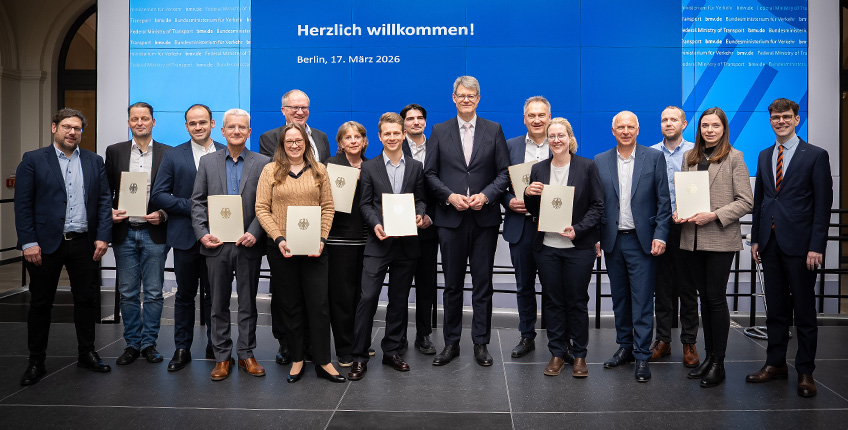
At its meeting on 26 February 2026, the German National Hydrogen Council (Nationale Wasserstoffrat (NWR)) made a substantial contribution to the Hydrogen and E-fuels in Transport Master Plan, which is being prepared by the federal government. The Council emphasised the strategic importance of hydrogen for transport, industry and the technological sovereignty of Germany.
“If we want to successfully transform transport, we must now act decisively. Especially when it comes to truck transport, hydrogen is not a niche topic, but rather in addition to electric mobility, it is an important building block for climate protection, security of supply and industrial competitiveness”, said Felix Christian Matthes, acting Chairman of the German National Hydrogen Council.
Key messages from the Council:
- Hydrogen as the key to major mobility sectors
Hydrogen plays a crucial role in segments with particularly considerable challenges in the transition to climate neutrality – including heavy-duty road transport, aviation and shipping as well as parts of the rail transport sector. - Two complementary drive technologies for road freight transport
Battery-electric and hydrogen-based drives should be regarded as two complementary technologies. They serve different application profiles and together, increase the resilience of the transport system. - Important industrial policy lever
Hydrogen mobility strengthens Made in Germany value creation, employment and technological leadership positions. Without a functioning domestic market, we risk losing core competencies to international competitors. - Infrastructure expansion must precede vehicle ramp-up
A comprehensive, expandable hydrogen refuelling station network – including 350 bar, 700 bar and in future, liquid hydrogen refuelling – is a precondition for market breakthrough and must receive governmental support at an early stage. - Security of supply through a hybrid mix
A flexible mix of local production, regional distribution and imports is needed to reduce price volatility and enable scaling. European harmonisation is key to this. - Create planning security for investments
Instruments should be examined that compensate for the cost differences between emission-free and conventional drives in the early market phase, thus creating investment security and supporting the market ramp-up. - Consolidate technological leadership
The National Innovation Programme for Hydrogen and Fuel Cell Technology (NIP) must continue beyond 2026 in order to advance research, industrialisation and scaling.
The ‘Master plan input’ statement of 26 February 2026 is available as a file attachment and can be downloaded under Statements.
Master plan input (PDF, 392 KB)
Source: www.wasserstoffrat.de