The nearly 60 members of Flensburg’s EES (Erneuerbare Energien und Speicher – Renewable Energies and Storage) association have actively championed the construction of the hydrogen filling station over the past few years.
Hydrogen is used to refuel electric vehicles with fuel cells. Their advantages: no noise, no pollutants, but the same utility, speed and range as passenger cars with petrol or diesel engines. Hydrogen vehicles have ranges of 500 to 700 kilometres and can be refuelled in just three minutes.
The network of stations at which fuel cell vehicles can refuel with hydrogen is becoming increasingly dense. In Germany there are now 71 H2 filling stations; by the turn of the year 2019/20 there will be 100. Further stations are currently being planned, for example in Westre
(North Frisia district) and Brunsbüttel (Dithmarschen district). The Shell network in Germany already has 25 hydrogen filling stations.
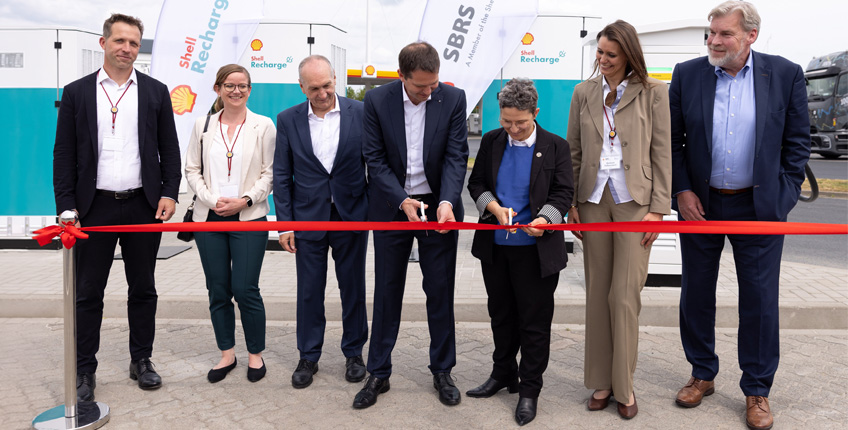
The new facility at the Shell station on Lecker Chaussee in Handewitt is located directly by the Flensburg/Harrislee exit of the BAB 7 motorway. It is a link on the routes from Hamburg to Denmark, Sweden and Norway, where there is also a network of 20 hydrogen filling stations already in place.
The owner/developer is H2 MOBILITY Deutschland, a joint venture tasked with establishing a hydrogen infrastructure in Germany. The filling station technology comes from Linde.
The hydrogen station in Handewitt is state of the art. Its operation by the driver is intuitive; refuelling is similar to that of conventional vehicles. The facility is equipped with the Linde IC90 ionic compressor, and holds around 200 kilograms of H2 – enough to refuel 40 to 50 vehicles a day.
The hydrogen station in Handewitt is funded by the European Commission in the trans-European Transport Network (TEN-T CEF) as part of the Connecting Hydrogen Refuelling Stations (COHRS) project.