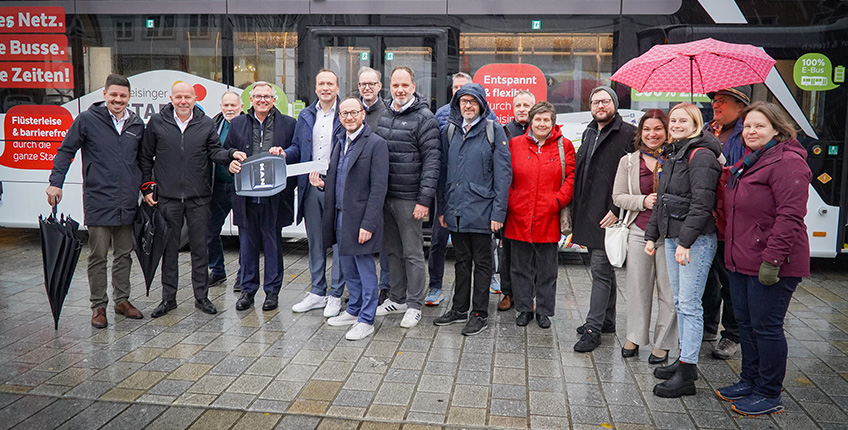
Federal Transport Minister Patrick Schnieder: “Electric buses are a key component of climate-friendly public transport. With the support of our funding, Freising is investing in modern infrastructure and clean, quiet and innovative electric buses, thereby completing the transition to climate-friendly drive systems in public transport. I am delighted that the Federal Ministry of Transport is able to support this project with around €8 million. Freisinger Stadtwerke is proving that the switch to e-buses works and brings many advantages – for passengers as well as for the climate and the environment.”
Mayor Tobias Eschenbacher: “We are focusing on a better network and more frequent services.” And commenting on the groundbreaking fact that the entire fleet is being converted in its entirety: “It’s an investment in the future that might hurt at the moment, but it was the right thing to do.”
Dr Bernd Rosenbusch, Managing Director of MVV (Münchner Verkehrs- und Tarifverbund) GmbH, has had very good experiences with e-buses so far: “E-mobility works!” And it is not only popular with those who use the buses but also with everyone else too, because the buses are environmentally friendly, quieter and cleaner.
The Freising e-bus fleet consists of 29 vehicles from the manufacturer MAN, nine of which are 10 metres long and 20 are 12 metres long. The electricity for this is generated from 100 percent renewable sources. The new buses, new timetables and a new network of routes will come into effect when the scheduled timetable changes. The schedule will increase by approximately 30 percent, from around 1,120,000 kilometres travelled to 1,480,000 kilometres per year in the future.
The ‘E-bus fleet with e-charging points for Freising city bus transport’ project is being funded by the Federal Ministry of Transport (BMV) with a total of €8,058,000 as part of the ‘Guideline for the Promotion of Alternative Drives for Buses in Passenger Transport” (“Richtlinie zur Förderung alternativer Antriebe von Bussen im Personenverkehr”), with additional funding also provided under the German Recovery and Resilience Plan (DARP – Deutscher Aufbau- und Resilienzplan) via the European Recovery and Resilience Facilities (ARF – Europäische Aufbau- und Resilienzfazilitäten) in the NextGenerationEU programme. The funding guideline is coordinated by NOW GmbH and implemented by Project Management Jülich (PtJ).

Image: Felix Matthey / Stadt Freising
Source: www.freisinger-stadtwerke.de