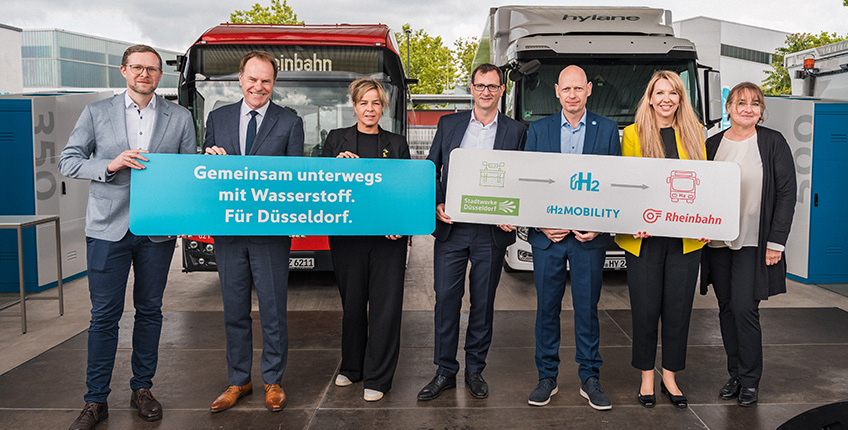
With a daily output of up to five tonnes of hydrogen, the new facility on Höherweg provides multiple times more capacity than conventional stations of the first refuelling station generation in Germany and sets new standards in the area of hydrogen mobility. Thanks to patent-pending high performance technology, now up to three vehicles can be refuelled at the same time, including buses, trucks as well as passenger cars and light commercial vehicles. This value-adding project is possible because of the close partnership between H2 MOBILITY, Stadtwerke Düsseldorf and Rheinbahn, who jointly conceived and implemented the topics of H2 production, H2 infrastructure and H2 demand in the framework of this project.
Christian Hirte, Parliamentary State Secretary at the Federal Ministry of Transport (BMV): “The opening of the most powerful hydrogen refuelling station in Europe is a strong signal for the ramp-up of hydrogen mobility in Germany – and for the cooperation of dedicated local partners. With our funding, we are providing targeted stimulus for developing regional hydrogen ecosystems that enable innovation, create added value locally and strengthen the technological competitiveness of Germany. Because it is clear that we will only reach our climate targets with innovation, infrastructure and cooperation – and this is precisely reflected in this project.”
The state government of North-Rhine Westphalia also sees the project as an important milestone on the road to decarbonisation of the transport sector. Minister for Economic Affairs and Climate Protection Mona Neubaur: “In areas that are difficult to electrify and precisely in places where battery-electric drives reach their limit, hydrogen helps to reduce emissions. With short refuelling times and long ranges, hydrogen vehicles play to their strengths, particularly in bus and heavy-duty transport. In order for fuel cell buses and trucks to really get on the road, inexpensive vehicles, a nationwide network of hydrogen refuelling stations and sufficient supply with green hydrogen is required. The state is actively driving the expansion forward, supporting the building of hydrogen refuelling stations for heavy commercial vehicles as well as initiatives for market ramp-up such as ‘1,000 fuel cell buses NRW’ and ‘HyTrucks.NRW’ as an important contribution on the road to climate-neutral transport.”
The expansion of hydrogen mobility in North-Rhine Westphalia is supported by the state energy agency NRW.Emergy4Climate, which acts as a central driving force for the development of regional hydrogen ecosystems. The refuelling station is a key component in the urban mobility and climate protection concept. Düsseldorf is pursuing the ambitious goal of becoming climate neutral by 2035.
Lord Mayor of Düsseldorf, Dr. Stephan Keller explained: “This new, extremely powerful hydrogen refuelling station that we have launched here in Düsseldorf on Höherweg shows that we in the state capital are on the right path to our goal of becoming climate neutral by 2035. Through consistent strengthening of local public transport, we are offering increasingly better alternatives to individual, motorised transport. The use of hydrogen- as well as electrically-powered buses in the Rheinbahn fleet and the expansion of the associated infrastructure are a plus for climate protection and modern mobility in Düsseldorf. I thank all those who participated.”
Frank Fronzke, Managing Director and COO of H2 MOBILITY, emphasized: “This refuelling station is a milestone for hydrogen mobility in Europe and represents a new generation of H2 refuelling stations with more pumps for 350, 500 and 700 bar, larger hydrogen volumes and a considerably more powerful technology. With our innovative high-performance technology, we are making fast, flexible refuelling possible for buses, trucks and cars, thus making a concrete contribution to the transport transition. The project demonstrates how cooperation between partners from industry and politics can accelerate innovation.”
Climate-friendly hydrogen, today
The refuelling station is already being supplied with renewable hydrogen (RFNBO) until Stadtwerke Düsseldorf’s electrolyser begins operation next year. This hydrogen comes from a certified source which uses exclusively renewable electricity for H2 production. The ecological footprint of hydrogen mobility at this refuelling station is therefore sustainable right from the beginning. The direct supply with locally-produced hydrogen from waste energy by Stadtwerke Düsseldorf’s electrolyser from 2026 onwards represents a cyclical solution and a pilot project for urban sector coupling. The electricity needed for this comes from biogenic parts of Stadtwerke Düsseldorf’s waste incineration facilities. This regional energy cycle reduces emissions significantly and in a sustainable way.
“I am delighted that we were able to develop and implement this project together. What makes this refuelling station so special is that from next year, it will be supplied exclusively with hydrogen generated decentrally by Stadtwerke Düsseldorf. We are building a two-megawatt electrolyser directly behind the refuelling station for this purpose. This creates local added value and avoids CO2 emissions in the transport of hydrogen. Together, we are making a considerable contribution to the decarbonisation of the mobility sector in Düsseldorf”, said Julien Mounier, CEO of Stadtwerke Düsseldorf.
For Rheinbahn, which already has 20 hydrogen buses in its fleet in the framework of its decarbonisation strategy, the new refuelling station in the immediate vicinity of its Lierenfeld depot represents an important infrastructural foundation.
“Hydrogen as an alternative drive system is a building block in our strategy to reduce CO2 emissions. We are investing in targeted way in this future technology in order to transform public transport in Düsseldorf and the region in a sustainable way. The new hydrogen refuelling station thus marks another milestone on our path to zero emission mobility. Now that it has begun operation, we are now optimally positioned in terms of infrastructure to refuel our hydrogen buses in a flexible and efficient manner and reliably use them in scheduled service. The vehicles have already proved themselves in daily service – our drivers like the driving comfort and their performance. Together with our strong partners H2 MOBILITY and the Stadtwerke Düsseldorf, we are actively advancing the transport transition and are coming considerably closer to our goal of climate neutrality in the region”, according to Rheinbahn board member Annette Grabbe.
A new generation of hydrogen refuelling stations
In its anniversary year of 2025, H2 MOBILITY looks back on ten years of pioneering work developing hydrogen refuelling stations nationwide. Under the motto: ‘TOGETH2ER’, the company is celebrating the partnerships that made the development of hydrogen mobility possible. The new station in Düsseldorf symbolises the progress of the past decade: a new generation of hydrogen refuelling stations that are specifically designed to fulfil the needs of logistics and public transport. With greater capacity, short refuelling times and the integration of renewable hydrogen sources, H2 MOBILITY is setting new standards for sustainable mobility in Europe.
The hydrogen refuelling station and the electrolyser are funded under the funding guideline for market activation measures in the framework of the National Innovation Programme for Hydrogen and Fuel Cell Technology Phase 2 (NIP2) by the Federal Ministry of Transport (BMV). The funding guideline is coordinated by NOW GmbH and implemented by Project Management Jülich (PtJ). The funding amounts to a total of 3,137,000 euros for the hydrogen refuelling station Düsseldorf-Höherweg (HyLight3) and 1,212,000 euros for the electrolyser.
Source original message: H2Mobility GmbH
Image rights: JACKZ Productions