
TCO Climate-Friendly Commercial Vehicles #2: The Costs
The second data story provides an overview of the TCO cost analysis, shows the composition of the cost components and analyzes selected cost points from the selected studies.
In order for climate-friendly vehicles to be used in heavy goods transport, the vehicles must be operated economically by logistics companies. The investment decision is made on the basis of the so-called “Total Cost of Ownership” (TCO) – the total costs of operation.
TCO (Total Cost of Ownership) refers to the entirety of all costs incurred over the lifespan of a product. A detailed analysis and planning of these cost components is of crucial importance in order to optimize the TCO and ensure the profitability of the vehicle over its entire life cycle. They are subject to a variety of influencing factors, such as the drive technology, the vehicle class, the operating conditions and regional conditions. To determine the amount of a specific cost component, all relevant factors are offset or multiplied by each other.
A list of all cost components of TCO is shown in the figure below. Various cost items can be summarized here, so that a focus on essential costs is possible. The other costs presented in the studies describe very different cost items in the various studies and are therefore difficult to compare. These are not considered in the further analysis.
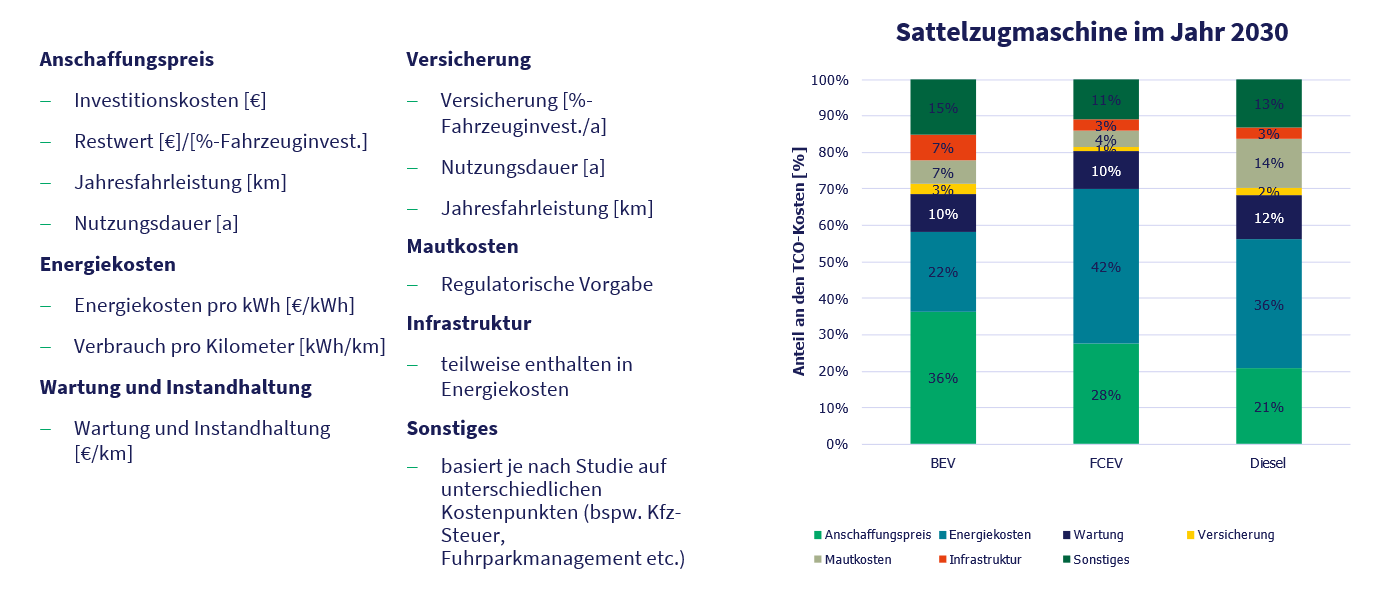
Selection of factors with the greatest influence on the TCO
For the further analysis of the studies and to ensure comparability between the studies, the most relevant factors for the calculation of the TCO, which are listed in the studies, are determined. The identification of the most influential factors is carried out by determining the average proportion of the cost components in the TCO over the studies considered. These are:
- Investment costs [€]
- Residual value [€]
- Annual mileage [km] / Service life [a]
- Energy costs per kWh [€/kWh]
- Consumption per kilometer [kWh/km]
- Maintenance and repair [€/km]
Analysis of the selected cost components
For the analysis of the essential cost components, a survey of numerical values from the selected studies for semi-trailer tractors was carried out. These are available in the dashboard below. It should be taken into account that within the studies the influencing factors are shown with different units. The respective unit of the factors is indicated. For a better representation of the sometimes large range of costs, the data are shown in the form of a box plot.
Cost items of the TCO
You are currently viewing a placeholder content from Default. To access the actual content, click the button below. Please note that doing so will share data with third-party providers.
More InformationIf the dashboard is not displayed completely, please click here.
In principle, the studies show a broad target picture for the life phases under consideration, taking into account the different framework conditions of the studies, and are therefore only comparable to a limited extent.
Further analysis and uncertainties
It can also be seen from the analysis of the studies that a large part of the studies do not cover all the essential framework conditions of the TCO. This shows that all studies work with certain uncertainties and that the values of the meta-study should also be considered with significant uncertainties. Personnel costs or diesel costs, among other things, can be mentioned here as an example.
In only four of the studies examined, the personnel costs are taken into account, whereby these account for up to 35% in the studies concerned. Since personnel costs therefore account for a significant proportion of the total costs, they are of decisive importance for the calculation of the TCO. In particular, when considering multi-vehicle requirements due to high range requirements, personnel costs can become particularly relevant.
Also to be mentioned here are the diesel costs. In contrast to electricity and hydrogen costs, these only have a small bandwidth until 2030. At the same time, the assumed costs are significantly below the already average diesel price of €1.6/l (corresponds to approximately 16 ct/kWh) today. This seems unrealistic in view of the current developments.
In general, the influence of, for example, CO₂ pricing or THG quota revenues is given very little consideration. For example, the effects of THG quota revenues can lead to significant shifts in cost-related ranges. The detailed analysis of this is described in Datastory #3 “Regulations”.
To the other TCO data stories