Promotion of Renewable Fuels
The German Federal Government has defined binding greenhouse gas emission reductions in the Federal Climate Change Act. Transport must make a significant contribution to this. In 2030, the transport sector may only emit 84 million tonnes of CO2, which corresponds to a reduction of 49% compared to 1990. To achieve this goal, renewable fuels play a crucial role, as not every application in transport can be electrified.
Today’s transportation is diverse. Due to varying usage requirements in passenger and freight transport, different drive technologies and fuel types will be needed in the future. In order to replace fossil fuels in the long term, renewable fuels—especially electricity-based fuels such as hydrogen and e-fuels, as well as advanced biofuels from waste and residual materials—will play an important role, in addition to the broad market ramp-up of electromobility. The Federal Ministry for Transport (BMV) promotes renewable fuels with a technology-neutral and cross-modal overall concept, which is supported by regulatory measures of the Federal Government.
The BMV addresses the technical challenges of market entry and plant scaling by supporting development and demonstration projects: firstly, in the form of a technology-neutral funding guideline for the development of regenerative fuels (Pillar I) and, secondly, by promoting the construction and operation of a development platform for electricity-based liquid fuels for air and sea transport (Pillar II). In order to address the economic obstacles to the market ramp-up of renewable fuels, the BMV is currently developing two F unding measures. A funding guideline is intended to support investments in production plants for renewable fuels (Pillar III). A further funding measure is intended to promote the market ramp-up of electricity-based kerosene (Pillar IV). The aim is to strengthen Germany’s technological leadership in this area.
Funding concept
In the funding guideline for the development of regenerative fuels, development and demonstration projects are funded that contribute to the further development and optimisation of technologies and processes for the production of renewable fuels. The funding is technology-neutral, i.e. projects on advanced biofuels as well as on electricity-based fuels can be funded. In addition, projects for all modes of transport are eligible for funding.
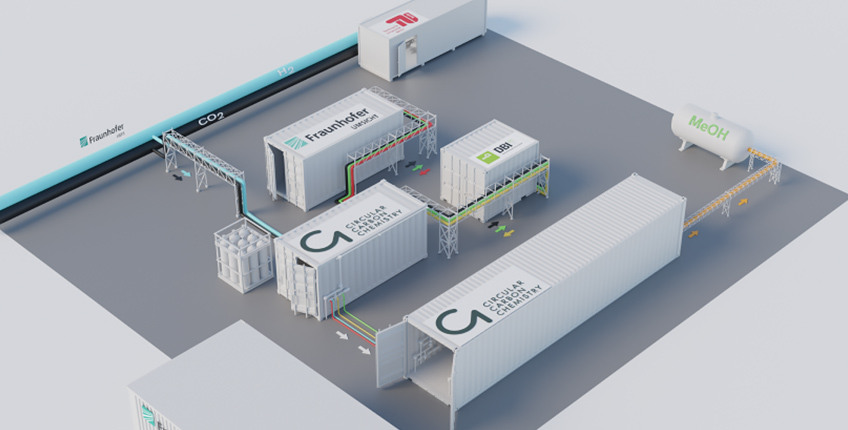
The construction and operation of a modularly designed large-scale research facility is also being funded. The platform will have a research and a demonstration strand and will have a production capacity of 2000-3000 tonnes of PtL fuel per year.
In the eK-Invest funding guideline, the construction or conversion of plants for the production of advanced biofuels and electricity-based fuels (including renewable hydrogen) is funded in a technology-neutral manner. The funding of feasibility studies, which examine the investment decisions for production plants with regard to their feasibility and market potential, is also possible.
In order to counteract the first-mover disadvantage, the BMV is promoting the market ramp-up of PtL kerosene with the PtL-KERO funding guideline. For this purpose, the difference between production costs and revenues is to be reimbursed by means of a double auction mechanism. Specifically, production plants with capacities of at least 10,000 tonnes of PtL fuel per year are to be funded, with at least 55% of the production capacity being used for PtL kerosene.
Due to the necessary budget consolidation and the focus on priority investments in rail and transport infrastructure, not all BMV funding programmes can be continued to the planned extent. Funds are currently not available for the planned measures to promote investments in production plants for renewable fuels (ek-Invest) and the market ramp-up of electricity-based kerosene (PtL-KERO).