
TCO Climate-Friendly Commercial Vehicles #1: Overview of Studies
This first of three data stories provides an overview of the methodology for selecting studies for the meta-study and an initial quantitative analysis of the selected studies.
The studies are based on very different initial situations. Assumptions for consideration periods, vehicle classes, drive technology and possible spatial scenarios vary greatly in all studies. For this reason, EMCEL GmbH, commissioned by NOW GmbH, has created a meta-study to provide an overview of the range of existing TCO analyses and studies.
In July 2024, climate-friendly commercial vehicles with a total weight of more than 3.5 t account for a very small proportion of the total stock at just 0.9194% (battery-electric vehicles 0.907% and fuel cell vehicles 0.0124%)
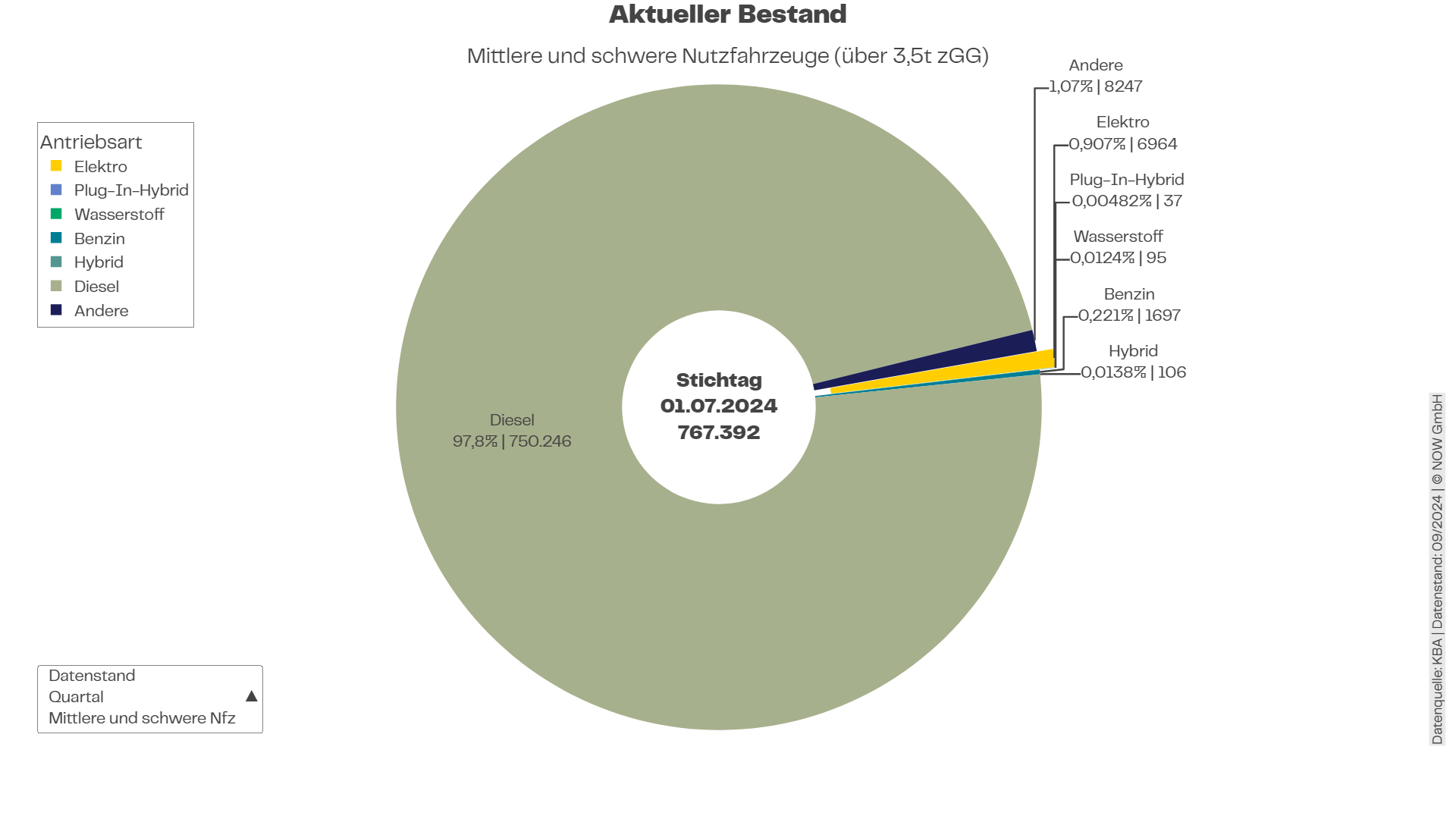
Both battery-electric drives and those with hydrogen fuel cells are still at the beginning of the market ramp-up for commercial vehicles, although significantly more battery-electric drives are already in use with approximately 5,000 vehicles in the fleet. The investment decision for a climate-friendly drive technology is made on the basis of the so-called “Total Cost of Ownership” (TCO). In order for climate-friendly vehicles to be purchased/rented and used in heavy-duty transport, the vehicles must be operated economically by logistics companies.
In order to provide an overview of the range of existing TCO analyses and studies, EMCEL GmbH, commissioned by NOW GmbH, has created a meta-study.
In general, very different initial situations exist for the creation of the studies. Assumptions for consideration periods, vehicle classes, drive technology and possible spatial scenarios vary greatly in all studies.
The aim of the meta-study and the associated analysis is therefore to summarise the different assumptions and numerical values of all selected studies and to provide a classification of the values in relation to each other for the target year 2030 – i.e. to set a framework for the forecasts of TCO values for climate-friendly commercial vehicles in the target year 2030. In addition, the results make existing uncertainties in the study situation visible, which can be deepened in the future through further work.
As there have been significant technological developments, particularly in the last six years, only studies with a creation year after 2018 were considered. A total of 46 studies on the costs and underlying cost assumptions of climate-friendly commercial vehicles were identified. In order to further limit the number of studies and ensure better comparability between the studies, further selection criteria were added. The criteria were:
- Study content: All studies had to consider at least one climate-friendly drive technology.
- Time horizon: Only studies that include the target year 2030 were considered.
- Cost assumptions: The studies contain assumptions and values and thus enable a calculation of the TCO of climate-friendly commercial vehicles.
- Study framework: A distinction was made as to whether studies make their own assumptions or refer with their values to other – already published studies.
After restricting the criteria, a total of 19 studies meet the requirements and will be further investigated as part of the meta-study.
The meta-study is based on a detailed literature review
You are currently viewing a placeholder content from Default. To access the actual content, click the button below. Please note that doing so will share data with third-party providers.
More InformationQuantitative analysis of the selected studies
In an initial quantitative analysis of the study selection, the studies can be subdivided according to the following aspects:
- Drive technologies
- Vehicle classes
- Consideration period of the study
- Region (Germany / EU / Worldwide)
- Scenario selection
It is interesting to note that most studies consider both drive technologies and do not clearly focus on one technology. The semi-trailer tractor is the most frequently studied vehicle class in the studies under consideration. Differences also exist in the consideration of different time periods and scenarios. More than half of the studies consider different scenarios. Examples of scenarios include different weight classes or different applications (regional and long-distance transport).
Quantitative information from the studies taken into account
You are currently viewing a placeholder content from Default. To access the actual content, click the button below. Please note that doing so will share data with third-party providers.
More InformationTo the other TCO data stories