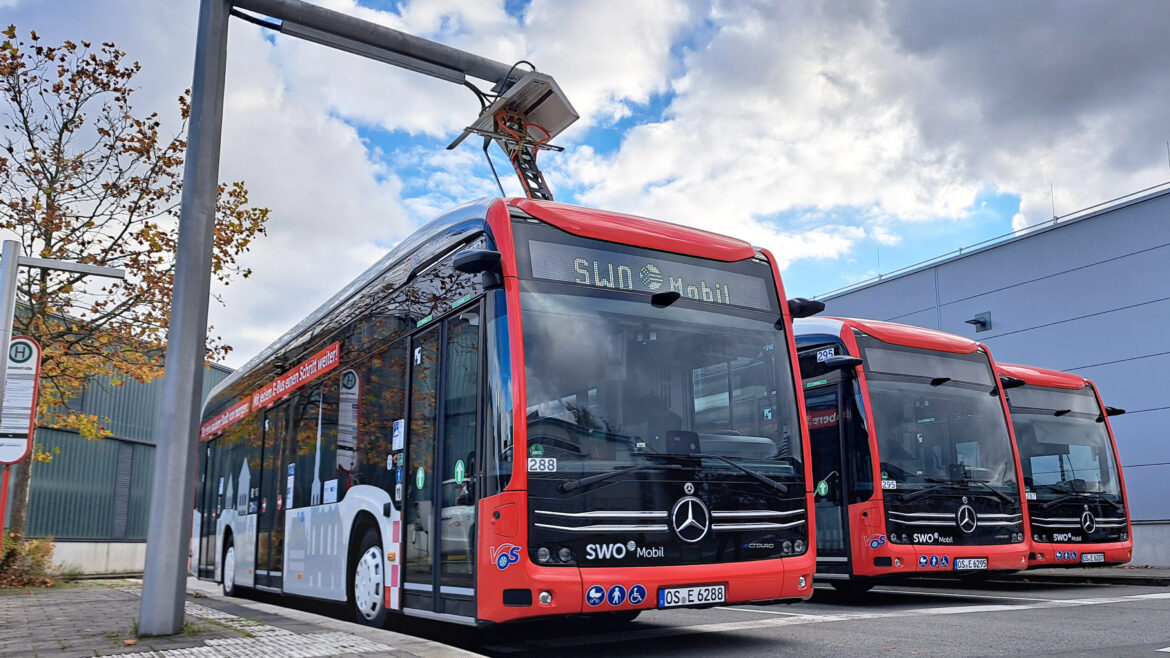
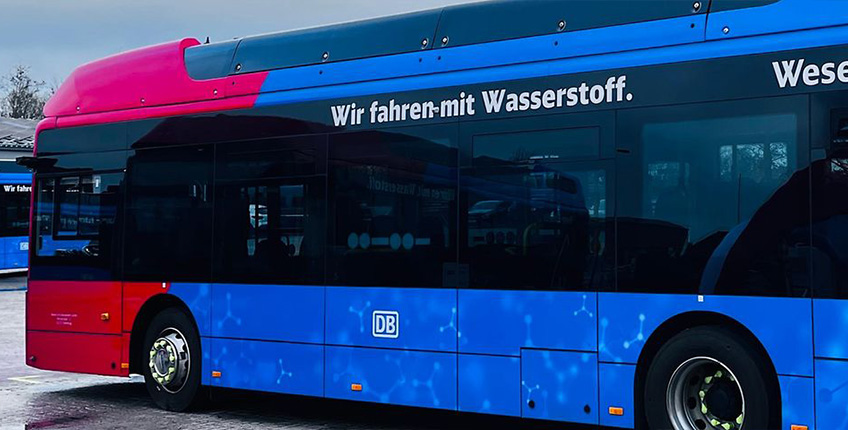
Deutsche Bahn (DB) is also driving forward the switch to alternative drive systems on the roads. Together with the district of Friesland, Weser-Ems-Bus, a subsidiary of DB Regio AG, yesterday presented six hydrogen buses that will be in service in the district with immediate effect. Initially, they will be refuelled at a mobile hydrogen filling station at the Weser-Ems-Bus depot in Jever. This station was installed in collaboration with the independent research institute Technologie-Transfer-Zentrum (ttz) Bremerhaven and the hydrogen manufacturer and supplier Lhyfe. In 2026, the operator Score plans to open a public hydrogen filling station. It is to be built in a convenient location in Schortens in the JadeWeserPark.
For Weser-Ems-Bus, the new hydrogen buses are the first zero-emission vehicles in service. Two electric buses will follow in the Ihlow service area. With the new vehicles, around ten percent of the DB Regio Bus Nord fleet in Lower Saxony, Bremen, Hamburg and Schleswig-Holstein will be emission-free. The expansion of the resource-saving bus fleet was supported by two funding packages from the Federal Ministry of Transport (BMV) totalling around 16.5 million euros. Thanks to this BMV funding, Weser-Ems-Bus was not only able to purchase the six fuel cell buses, but also to expand the charging infrastructure and maintenance facilities. The district of Friesland is covering the additional costs of €450,000, thereby actively investing in modern and sustainable public transport.
Patrick Schnieder, Federal Minister of Transport: “Zero-emission buses are the basis for making public transport both appealing and climate-friendly. The Federal Ministry of Transport is actively supporting the conversion of fleets to climate-neutral buses and providing DB Regio Bus Nord with €16.5 million in funding for the changeover. Soon, one in ten DB buses in Lower Saxony, Bremen, Hamburg and Schleswig-Holstein will be emission-free – an important step towards climate-friendly mobility in northern Germany.”
Arne Schneemann, Board Member of DB Regio Straße: “We are actively shaping the future of mobility and taking our responsibility for climate protection seriously. With the support of the BMV funding and in cooperation with the district of Friesland, we have taken a big step in the right direction. The new buses are eye-catching and offer a high level of comfort and low levels of noise for our passengers. Last but not least, they are also an appealing work vehicle for our drivers. All of this increases the value of public transport in the region.”
Sven Ambrosy, District Administrator in the district of Friesland: “I am very proud that we are now able to put our hydrogen bus project into operation. It is particularly important for us to continue pursuing our climate protection goals in our World Heritage region. Frieslandtakt and new vehicles represent an attractive proposition for passengers, both tourists and locals alike. Hydrogen mobility is still in its infancy in Germany, and a project like this can only be realised through good partnerships. I would like to thank everyone involved who contributed their expertise and their perseverance!”
The fuel cell buses are manufactured by the Portuguese company Caetano. They have a range of up to 590 kilometres. The hydrogen tanks installed on the roof have a capacity of 37.5 kilograms of hydrogen. A fuel cell manufactured by Toyota continuously charges a battery that powers the bus.
The procurement of a total of 152 buses with alternative drive systems by DB Regio Bus Nord is being funded by the BMV with a total of 16.5 million euros as part of the ‘Guideline for the Promotion of Alternative Drive Systems for Passenger Buses’ (‘Richtlinie zur Förderung alternativer Antriebe von Bussen im Personenverkehr’). Funding for this measure is also being provided as part of the German Recovery and Resilience Plan (DARP – Deutcher Aufbau- und Resilienzplan) via the European Recovery and Resilience Facility in the NextGenerationEU programme. The funding guideline is coordinated by NOW GmbH and implemented by Project Management Jülich (PtJ).
Detailed information on climate-neutral public transport in the north of Germany is available at: www.dbregiobus-nord.de/aktuell/mobilitaetswende
Source: DB AG
Image: Angelika Theidig